

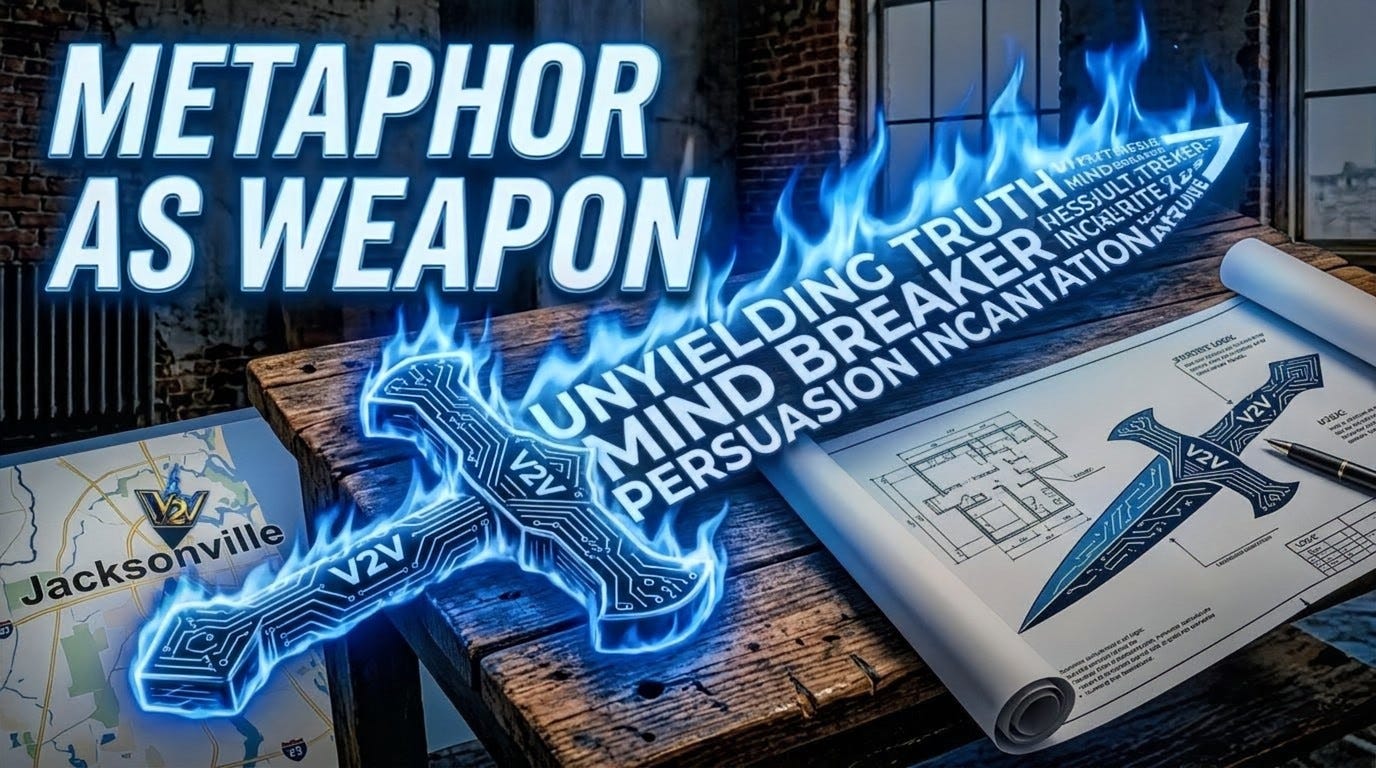
Metaphor as Weapon
You cannot demolish a belief with logic alone.

Logic negotiates.
Metaphor penetrates.
If shame is red ink and trauma is imprint, metaphor is leverage. It gives you psychological distance from what once felt absolute.
The reason identity feels permanent is because it feels literal.
• "I am broken."
• "I am behind."
• "I am not enough."
Literal language locks you inside the sentence.
Metaphor unlocks it.
• "I am rebuilding after impact."
• "I am between seasons."
• "I am under construction."
One version is a verdict.
The other is a process.
Metaphor does not deny reality.
It reframes scale.
And scale determines possibility.
Why the Brain Responds to Symbol
Your brain stores experience narratively.
But it processes threat emotionally.
When you say, "I failed," your nervous system often reacts as if the event is happening again. Heart rate shifts. Shoulders tense. The memory becomes present.
But when you say, "That season was a storm," something changes.
Storms are temporary.
Storms pass.
Storms reshape landscapes but do not end geography.
Metaphor introduces movement.
It transforms identity from static label to dynamic scene.
Case Study: Lena
Lena went through a painful divorce at 35. For two years she described herself as "damaged."
That word did damage.
It implied defect. Reduced value. Permanent impairment.
In coaching, she reframed her experience as:
"A house that went through a fire."
Notice the difference.
A burned house is not worthless.
It requires renovation.
It requires clearing.
It may even be rebuilt stronger.
When Lena shifted language, her decisions shifted. She stopped avoiding dating. She stopped apologizing for her past. She began rebuilding.
The event did not change.
The metaphor did.
And metaphor changed identity.
Turning Memory into Symbol

Most painful memories replay in literal form.
You see the room.
You hear the tone.
You relive the feeling.
Literal memory traps you inside the moment.
Symbolic reframing places the moment inside a larger narrative.
Here's the method:
Step 1: Isolate the Emotional Core
Was it humiliation?
Rejection?
Powerlessness?
Abandonment?
Name the emotion cleanly.
Step 2: Translate Emotion into Image
If that emotion were a scene, what would it be?
• A locked door
• A cracked mirror
• A dim hallway
• A broken bridge
Do not overthink it. Choose the first image that feels accurate.
Step 3: Expand the Scene
Ask:
• Is the door permanently locked?
• Can bridges be rebuilt?
• Can mirrors be replaced?
• Is the hallway endless—or does it turn?
The brain cannot hold permanence when the image implies change.
That's why metaphor is powerful.
It injects mobility into stuck identity.
From Victim Narrative to Author Narrative
There are two ways to describe hardship.
Victim language:
"This ruined me."
Author language:
"This shaped me."
The first closes story.
The second continues it.
This is not about minimizing harm.
It is about reclaiming agency.
Case Study: Marcus (from earlier chapters)
He described himself as "overlooked."
That word implied passivity.
When challenged, he reframed:
"I've been sharpening in quiet rooms."
That metaphor changed his posture.
Overlooked suggests invisibility.
Sharpening suggests preparation.
One identity shrinks.
The other accumulates strength.
Metaphor doesn't just reframe the past.
It influences the future.
If you believe you are sharpening, you prepare differently.
If you believe you are overlooked, you withdraw.
Language shapes action.
Metaphor as Demolition Tool
You can use metaphor not only to heal but to dismantle limiting beliefs.
Take a limiting belief:
"I'm bad at leadership."
Translate it symbolically:
"My voice feels like a dim lantern in a crowded room."
Now interrogate the image:
• Is the lantern broken—or simply low on fuel?
• Is the room truly crowded—or is your perception exaggerating threat?
• What happens if you bring the lantern closer to the center?
Suddenly, the belief becomes mechanical rather than moral.
Fuel can be added.
Position can change.
Lighting can expand.
Metaphor moves the belief from identity flaw to adjustable condition.
And adjustable conditions can be improved.
Designing Empowering Symbols
Metaphor is neutral.
It can weaken or strengthen.
Be intentional about the symbols you choose.
Instead of saying: "I'm starting over."
Try: "I'm relaunching."
Starting over implies erasure.
Relaunching implies iteration.
Instead of: "I lost everything."
Try: "I cleared the board."
Loss implies scarcity.
Clearing implies space.
Small shifts. Massive impact.
Now let's make this practical.
Practical Application: The Identity Symbol Exercise
1. Write one current struggle in literal form.
Example: "I feel behind in my career."
2. Translate it into a symbol.
"I feel like I'm running a race that already started."
3. Interrogate the symbol.
• Who set the start time?
• Is it truly a race?
• What if it's a marathon?
• What if it's not competitive at all?
4. Redesign the metaphor intentionally.
"I am pacing for a long-distance run."
Notice how behavior shifts under each image.
Race = panic.
Pacing = strategy.
The external circumstances did not change.
The narrative did.
Weaponizing Narrative for Growth
You are not trying to create delusion.
You are creating directional truth.
Metaphor gives you leverage over your internal language.
And leverage multiplies momentum.
When you say: "I am rebuilding,"
you look for bricks.
When you say: "I am learning,"
you tolerate mistakes.
When you say: "I am becoming,"
you allow time.
Identity is not just a record of what has happened. It is a prediction of what you permit.
Metaphor influences prediction.
And prediction shapes effort.
The Bridge to Belief Architecture
We've now uncovered three layers:
• External editors
• Internal shame
• Narrative reframing through metaphor
But metaphor alone cannot sustain transformation.
You can redesign the image.
But if the underlying belief remains intact, the old structure will reassert itself.
If you believe "success is dangerous," no metaphor about growth will hold.
If you believe "visibility leads to rejection," you will dim the lantern again.
So now we move beneath symbol.
To belief.
To the beams that hold identity upright even when you repaint the walls.
In the next chapter, we examine belief architecture—the structural system beneath your n
arrative—and decide which beams deserve reinforcement and which require demolition.
Metaphor gave you leverage.
Belief will determine permanence.
Your Move
Try the Identity Symbol Exercise today.
Choose one struggle and translate it into a metaphor. Interrogate and redesign it.
Share your before/after metaphor in the comments. Let's see how reframing shifts your perception.
If someone you know is stuck in literal thinking, send them this. Sometimes a new image is all they need.
Stay sharp,
—The Napalmjax Protocol